

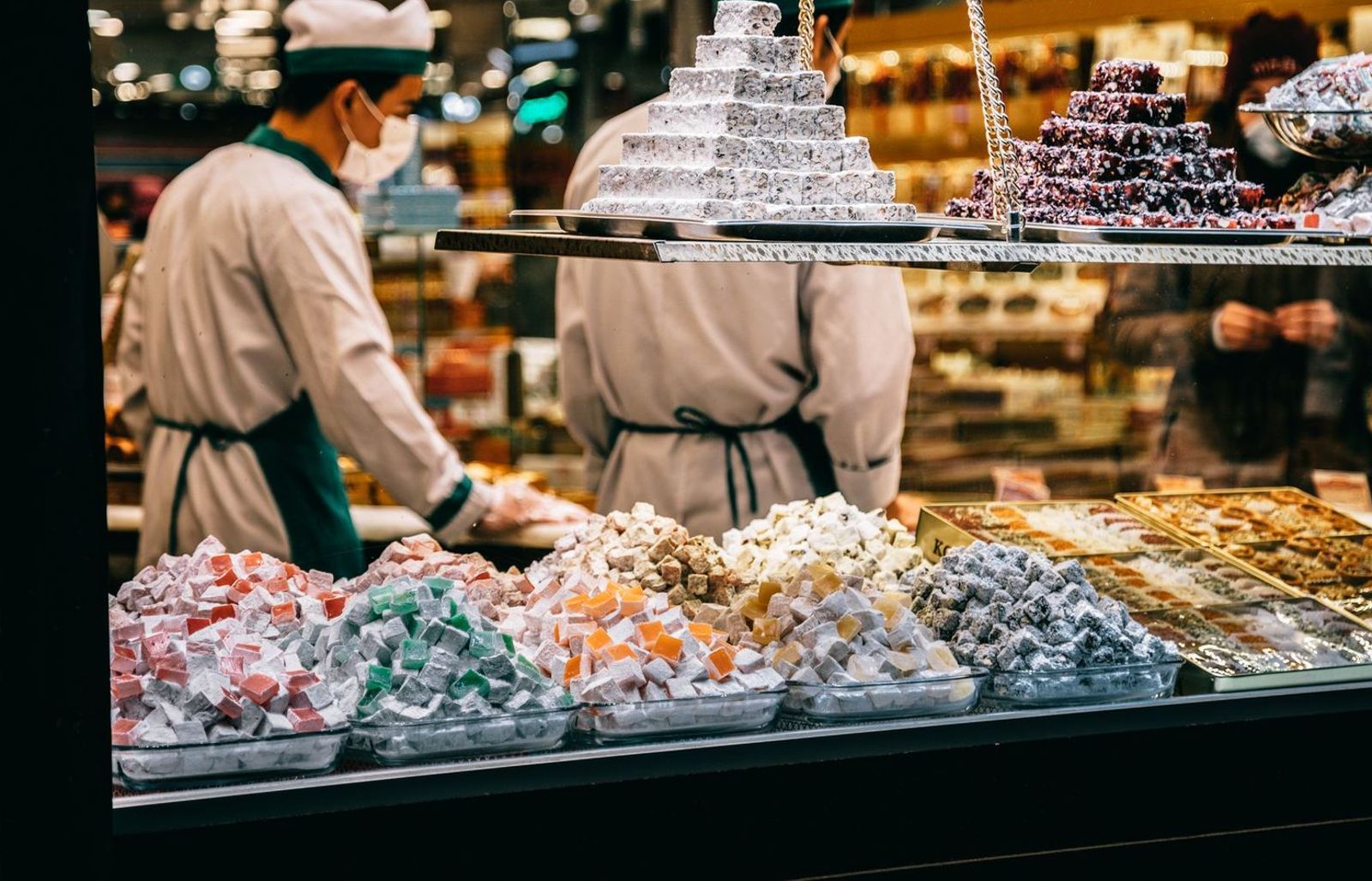
Why a sweet of four ingredients takes five hours, how the consistency is judged and how to recognise good Turkish delight.
Turkish delight has one of the shortest ingredient lists of any sweet: sugar, water, starch and a pinch of citric acid. But this simplicity is misleading. Good Turkish delight is the product of patient cooking that lasts for hours at the copper cauldron, and of the master's eye. Let us walk you step by step through how a batch is made in our workshop.
1. The syrup
Water and sugar go into the cauldron first and are heated until the sugar dissolves completely. Citric acid is added at this stage; its job is to turn some of the sugar into invert sugar and stop the delight from crystallising and turning grainy later.
2. Adding the starch
Corn starch is mixed with cold water in a separate container into a lump-free liquid and added slowly to the boiling syrup. From this moment, the stirring never stops. Masters once stirred by hand with a long paddle; today our cauldrons have slow-turning mechanical stirrers, but control of the heat and consistency is still with the master.
3. Long, slow cooking
Turkish delight cooks over a low heat for 4.5–5 hours. During this time the starch gels completely, the water evaporates gradually and the mixture thickens into a translucent, golden paste. Raising the heat to shorten the time is not possible: the delight catches on the bottom, darkens and becomes hard.
4. How is the consistency judged?
Our master watches how the delight flows from the ladle: at the right consistency it falls not like a thread but as a thick, slow ribbon. Dropped into cold water, a spoonful does not dissolve but keeps its shape. In modern workshops this is also confirmed by measuring the sugar content (Brix) with a refractometer; our target is 78–80%.
5. Flavours and nuts
Flavourings such as rose water, pomegranate juice or mastic are added in the last minutes; added early, they evaporate with the steam. Pistachios and hazelnuts also go into the cauldron in the last half hour.
6. Resting and cutting
The paste is poured into starch-dusted trays and rested for 24 hours. The next day the delight is turned out of the tray, cut into cubes, bars or rolls and coated in icing sugar, starch or coconut.
How to recognise good Turkish delight
- It resists the teeth slightly and does not stretch like rubber.
- It melts slowly in the mouth and leaves no grainy feeling.
- The cut surface is shiny and smooth, with no air bubbles.
- It tastes of its flavouring more than of sugar.
The Turkish Food Codex Communiqué on Turkish Delight defines the product and the ingredients that may be used. A delight with a short ingredients list on its label is usually on the right track.
Related Posts

Delight Workshop
How to Store Cream Turkish Delight: A Guide to the Fridge, Shipping and Serving
Why Afyon's favourite delight is kept in the fridge, how it is protected in shipping and how long to leave it out…
Read more